50 years of procrastination is enough.

Stop the untreated snow dumping in our drinking water.

Since 1 January 1972, Swedish law has prohibited dumping waste into water[1]. Yet for over five decades, the City of Stockholm has repeatedly sought exemptions to dump hundreds of tonnes of untreated street snow contaminated with heavy metals, oil, tyre particles and microplastics into Lake Mälaren and Saltsjön[8][4].

Ahead of the local election in September 2026, we as Stockholm residents, parents, taxpayers, swimmers and environmental advocates demand that city politicians stop applying for exemptions and pass a binding decision to end untreated snow dumping once and for all.

Sign the petition on MittSkifte

The petition is hosted on MittSkifte, the citizen campaign platform run by Skiftet.

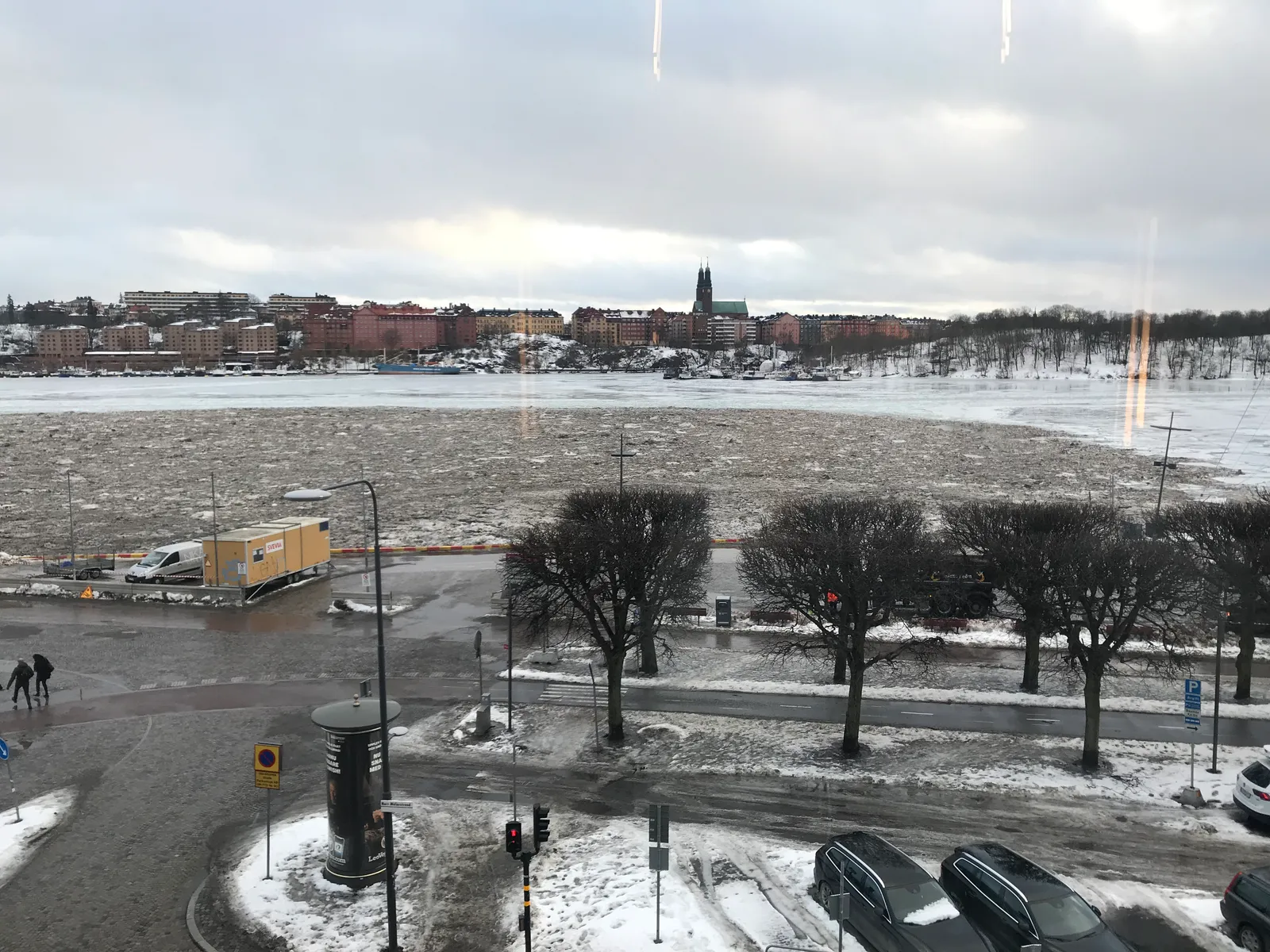
Riddarfjärden seen from above on a winter day. The water is covered in ice and brown, dirty slush, bare trees and parked cars line the quay, and across the water the Södermalm skyline is visible with the twin towers of Högalid Church.
A winter view over Riddarfjärden. Norr Mälarstrand, Kungsholms hamnplan, 2019-02-08. Photo: Anna Lilja

Toxic road slush in our drinking water reservoir

Street snow is not clean precipitation. When snow sits on streets and urban squares, it acts as a sponge for urban traffic pollutants. When the city loads snow onto trucks for removal, it legally becomes waste under the Swedish Environmental Code and the EU Waste Framework Directive[2][8].

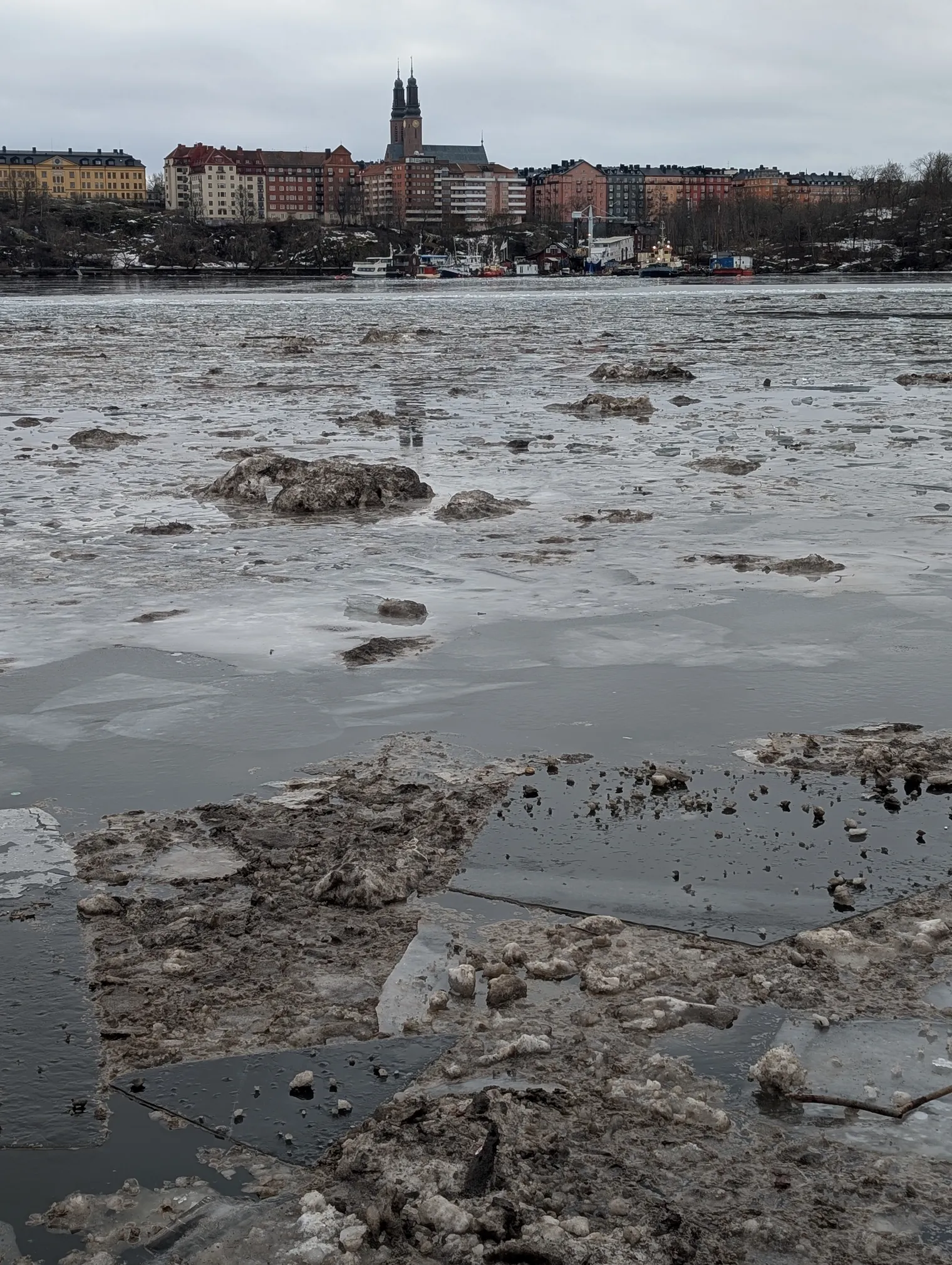
Ice floes covered in brown, dirty slush drifting on Riddarfjärden. Across the water, the Södermalm skyline is visible with the twin towers of Högalid Church.
Contaminated, dirty small icebergs on Riddarfjärden. Riddarfjärden, view towards Södermälarstrand, 2026-02-27. Photo: Mats Sommarström

Heavy metals

Inner-city snow contains high concentrations of copper from brake pads, zinc from tire wear, and lead[8].

In its exemption application, the Traffic Department claimed that snow dumping adds only 0.4–0.6 kg of copper and 1–1.5 kg of zinc per year[4]. However, the Environment Department rejected this calculation because it completely omitted particle-bound metals[4].

The actual annual input into Stockholm's waters is instead estimated at 7–11 kg of copper and 28–42 kg of zinc[4], with Norr Mälarstrand alone contributing up to 8 kg of copper and 2.6 kg of lead to Lake Mälaren[8].

Microplastics and tyre particles

Measurements demonstrate that meltwater from inner-city snow contains between 100 and 10,000 microplastic particles per litre[22], up to 245 times higher than in ordinary urban stormwater[8].

PAHs and oil

Polycyclic aromatic hydrocarbons and petroleum products from vehicle exhaust and fluid leaks accompany the snow and accumulate in seabed sediments. Elevated levels of PAHs, oil index and heavy metals have been documented in sediments at the dumping sites[8].

Bulky waste and debris

It is not only microscopic pollutants that accompany the dump trucks. Divers from the environmental organization Hands2Ocean report that everything concealed beneath the street snow cover is scooped up and dumped directly into the water[26].

On the seabed beneath dumping locations, divers routinely find e-scooters, heavy construction waste bags (Big Bags), traffic cones containing PFAS, and large quantities of general debris[26].

Threat to drinking water

Lake Mälaren serves as the drinking water reservoir for over 2.3 million people[8]. Discharging environmental toxins into a freshwater recipient west of Slussen jeopardises water quality in the region's primary raw water supply.

Millions for recreation and remediation – millions for pollution

Within the City of Stockholm, publicly funded operations work in direct conflict with one another. Three parallel decisions within the same municipality target the exact same body of water:

  1. Trafikkontoret

    The city builds swimming facilities

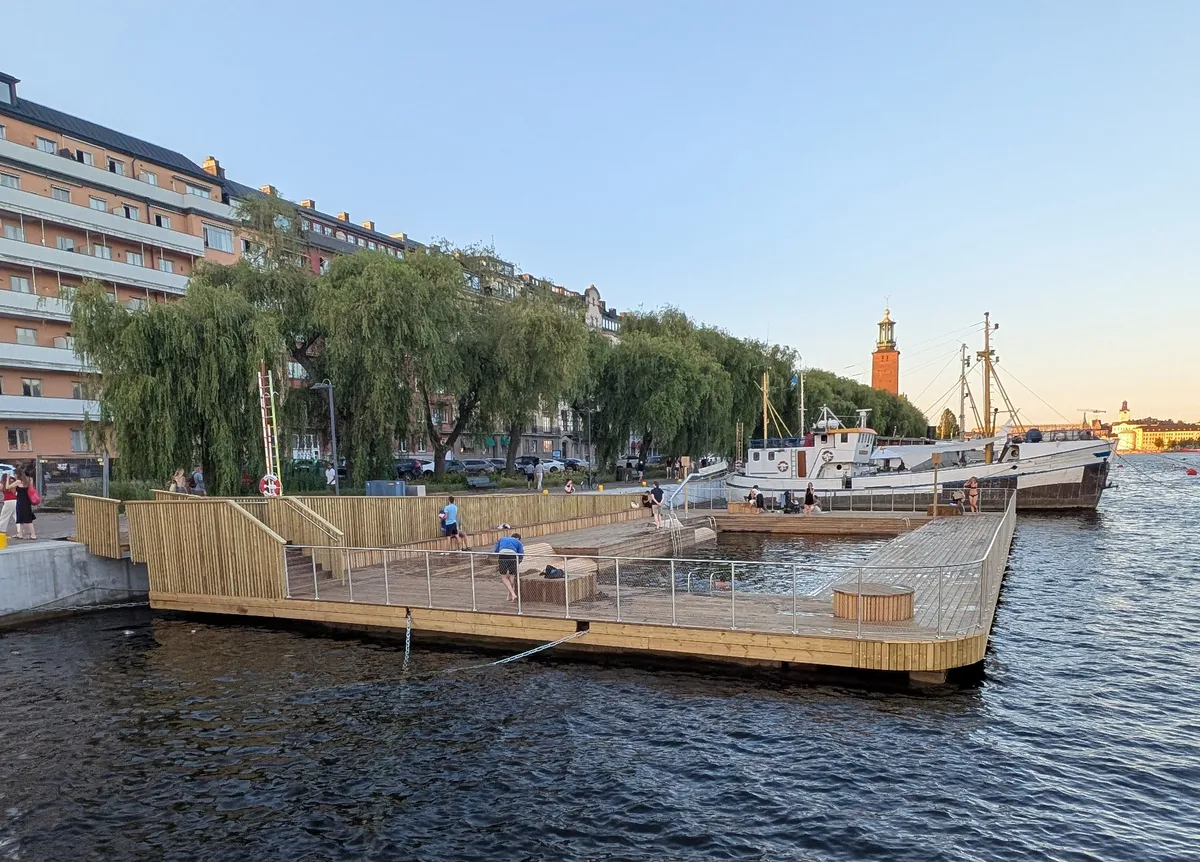
    Completing a new floating swimming facility at Norr Mälarstrand in summer 2026 at a cost of SEK 5.7 million. To enable winter swimming, the facility is equipped with water flow makers, while the city simultaneously orders snow dumping directly adjacent to it.[23][24]

    A newly built wooden pier with a swimming pool at the quayside on a summer evening. People are swimming and sunbathing on the pier, a white vessel is moored alongside, and the tower of Stockholm City Hall is visible in the background.
    2026-08-19. Photo: Mats Sommarström
  2. Stockholm Vatten och Avfall

    The city cleans up

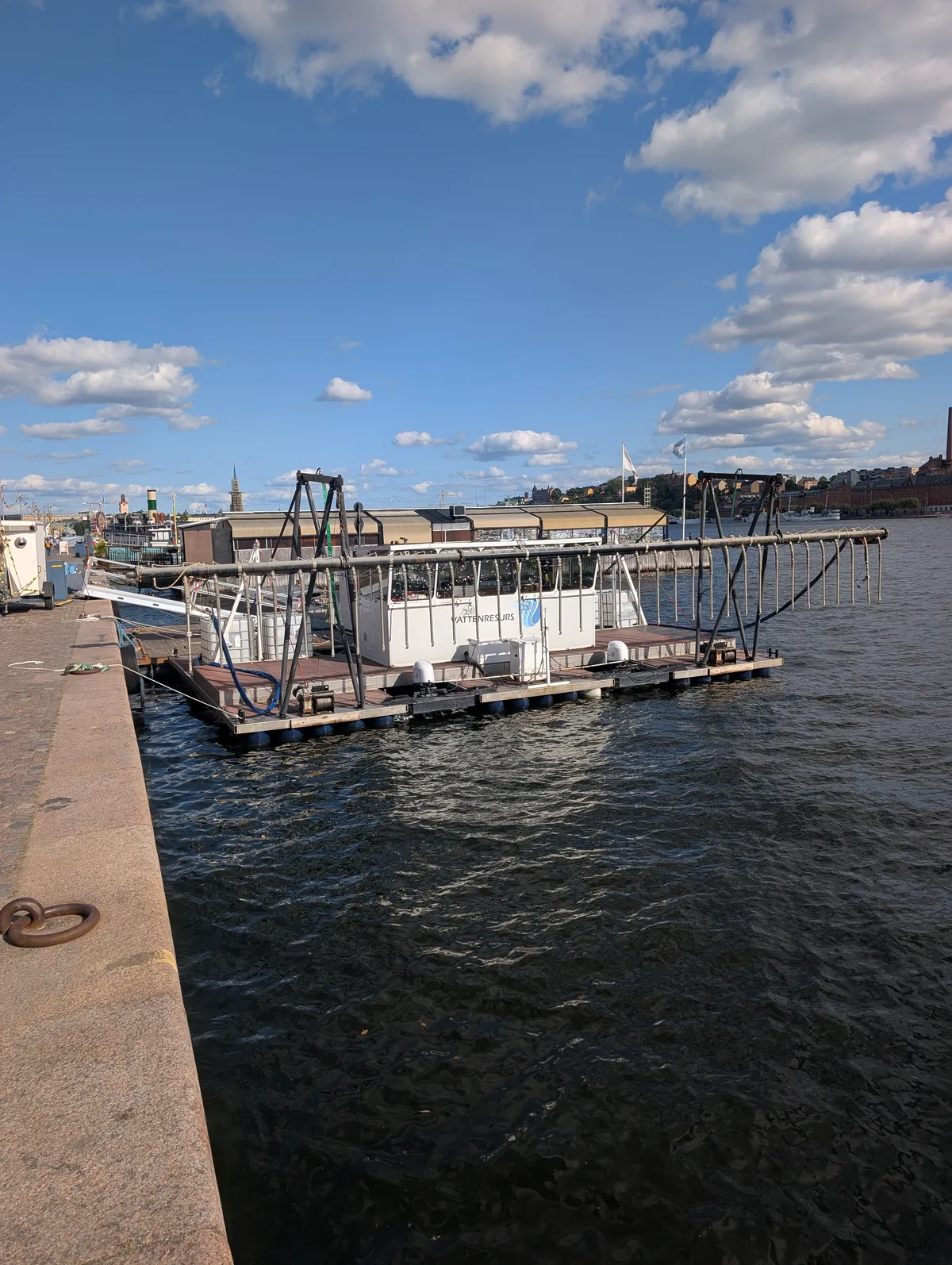
    Executing a large-scale chemical precipitation project using aluminium chloride in Riddarfjärden during 2025–2026 to bind phosphorus in sediments and restore the aquatic environment. The Development Committee approved an execution budget of SEK 18.4 million, and treatment of Riddarfjärden concluded in August 2026.[16][17][20][18][19][21]

    A white work pontoon marked Vattenresurs moored at a granite quay on a sunny summer day. A long boom with hanging hoses extends from the pontoon out over the water. Södermalm is visible across Riddarfjärden.
    2026-08-11. Photo: Mats Sommarström
  3. Trafikkontoret

    The city pollutes

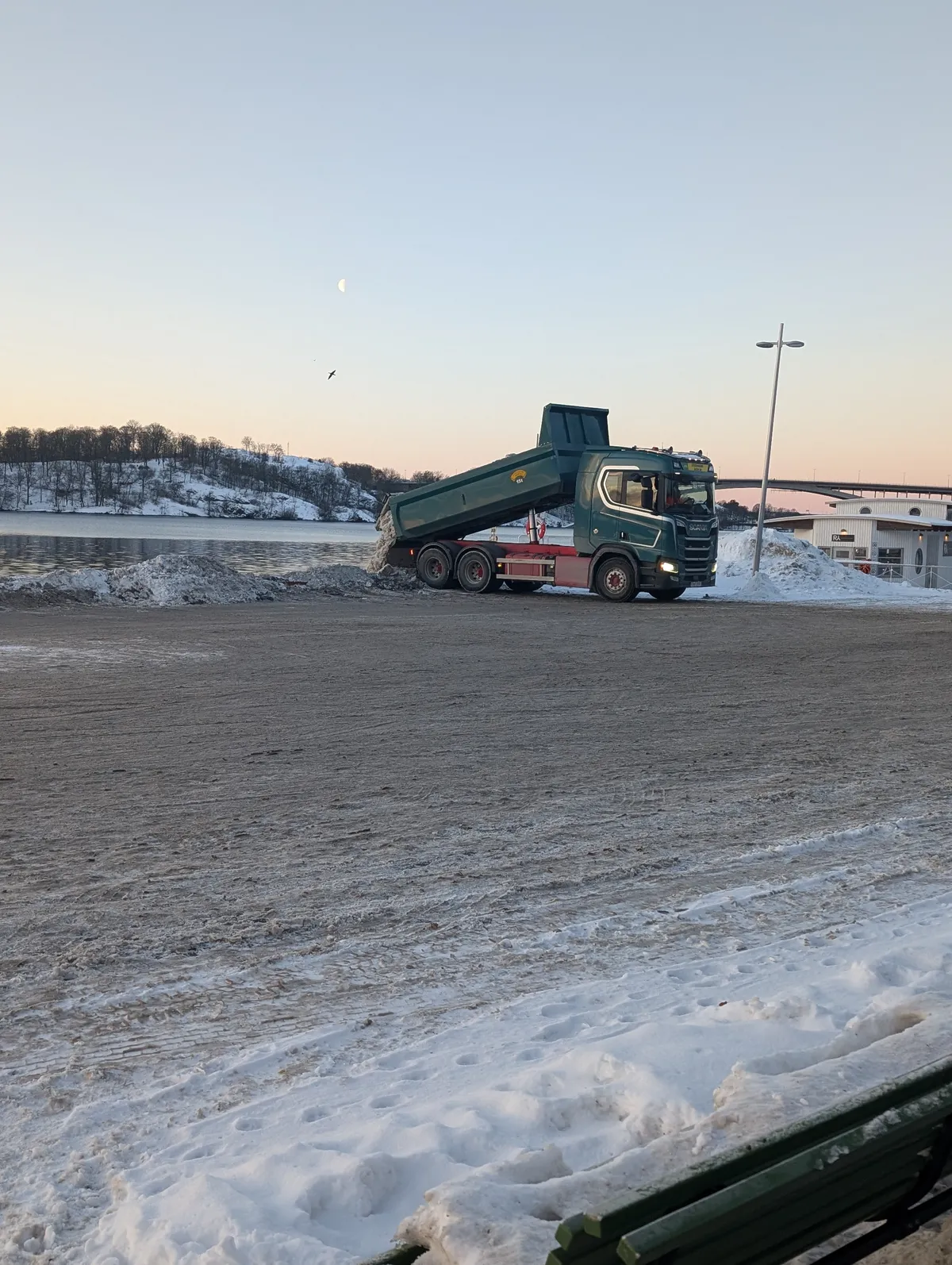
    Simultaneously applying for regulatory exemptions to dump up to 800,000 m³ of untreated street waste per year onto the exact same seabed.[4]

    A green tipper truck discharging snow at the water's edge on a snow-covered quay at dusk. Lake Mälaren, a bridge and ploughed snow piles are visible behind the vehicle.
    2026-01-10. Photo: Mats Sommarström

All three decisions converge in Riddarfjärden, a direct component of Lake Mälaren's drinking water reservoir.

This represents financial inefficiency and political hypocrisy. Taxpayers cannot be expected to fund water remediation in the summer while the municipality is permitted to pollute the same water body in the winter.

What are we teaching the next generation about law and justice?

Every winter, ice forms across Riddarfjärden and brown, contaminated icebergs drift across the water. Children ask the simple questions that adults find difficult to answer:

  • Is it allowed to throw poison into the water we drink?
  • How are the fish and the organisms on the bottom surviving?
  • Why do we have to follow rules if the municipality doesn't?

Across Sweden, citizens are monitored and fined if they fail to sort household packaging correctly[12][13][14][15]. Yet in the same society, authorities and politicians routinely grant exemptions that legalise municipal pollution on an industrial scale.

When children grow up in a city that has sought loopholes for over 50 years to avoid complying with its own environmental legislation, what moral standard is being established? If the municipality can bypass environmental laws with bureaucratic jargon and exemptions, teenagers cannot be expected to respect public order bylaws in city parks.

Over 50 years of exemptions and loopholes

The legal baseline under the Swedish Environmental Code is clear: dumping waste into water is prohibited as a general rule[2]. Yet the exemption system has transformed from a temporary emergency measure into a permanent fixture of Stockholm's annual winter operational budget[4].

  1. Dumping waste into water is prohibited under Swedish law[1]

    The prohibition takes effect on 1 January 1972 (Act 1971:1154).

  2. The EU Water Framework Directive establishes that water status must not deteriorate[6]

  3. The first written, documented snow dumping exemption for Stockholm[4]

    The earliest exemption that can be documented in public records.

  4. Oslo deploys the treatment barge S/S Terje, ending untreated sea dumping[9]

  5. The EU Court of Justice delivers the Weser ruling[3]

    Case C-461/13: prohibiting the deterioration of individual quality elements.

  6. The County Administrative Board grants Stockholm a new five-year exemption[4]

    Dnr 36542-2025. Up to 800,000 m³ per year across four sites, valid 8 April 2026 to 8 April 2031.

  7. Chapter 15 of the Swedish Environmental Code is restructured[7]

    The prohibition moves to Ch. 15, Sec. 40 and exemptions to Sec. 42, through Act 2026:507.

  8. Finland's statutory ban on dumping snow into the sea enters into force[5]

    The act was adopted in 2025 (Act 144/2025) and enters into force on 1 May 2028.

The Weser ruling and the calculation of impact

Under the European Court of Justice ruling in the Weser case[3], an authority may not grant authorisation for an activity that risks deteriorating the status of an individual quality element in a water body[6]. If a quality element such as lead or PAHs is already in the lowest status class, any additional input constitutes an illegal deterioration under EU law.

The County Administrative Board of Stockholm justifies its exemptions by claiming that snow pollution represents less than 0.2 per cent of the total anthropogenic load and is therefore negligible[4]. However, evaluating new discharges relative to an already high baseline concentration directly violates the Weser principle. Poor water quality does not provide legal headroom for additional pollution – it mandates a complete cessation of discharges.

The solutions exist and are proven

The Traffic Department repeatedly asserts that alternative technical solutions are lacking[4]. This assertion is incorrect. Commercially viable solutions have existed for over a decade, and the opportunities for Stockholm are evident if politicians and officials are willing to think along new lines. This is not a question of technology. It is a question of will.

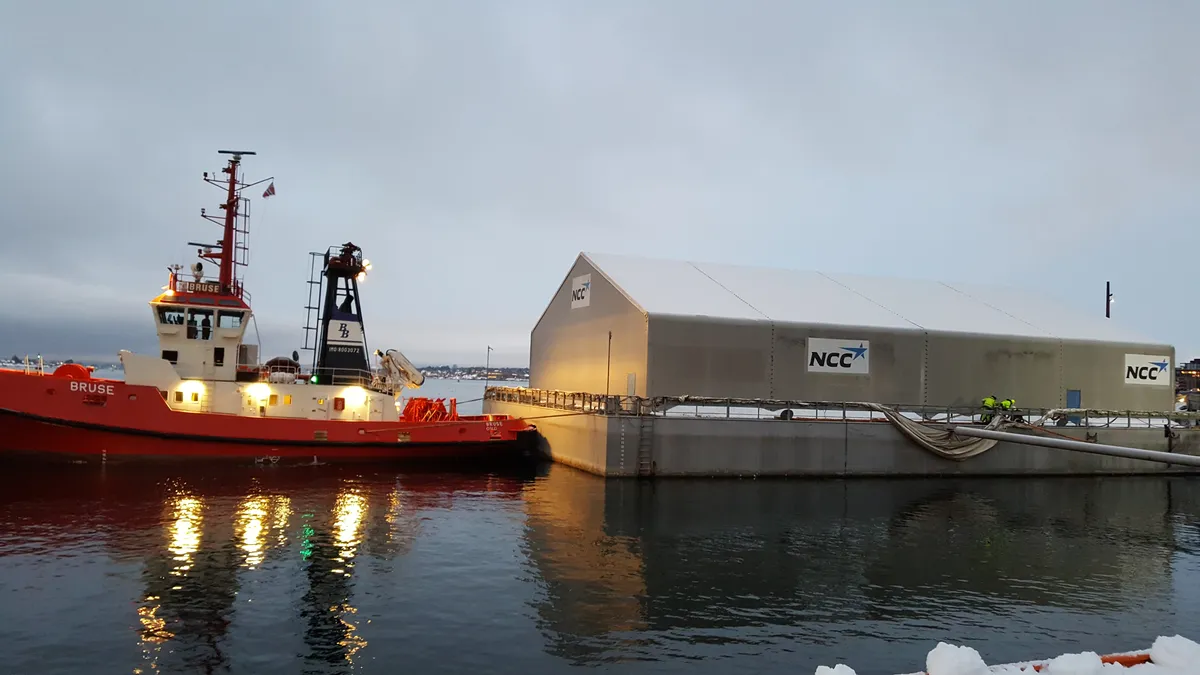
Oslo's solution: NCC SnowClean, S/S Terje

In Oslo, the Swedish construction company NCC deployed the specialised treatment barge S/S Terje, which has been in continuous operation since January 2012.[9]

  • Seawater thermal energy: the barge pumps in seawater at approximately four degrees Celsius from a depth of 23 metres. Thermal energy in the seawater melts the snow without consuming fuel or primary heating energy.
  • Full-scale treatment: meltwater passes through coarse separators, oil interceptors and cyclone filters that capture over 90 per cent of heavy metals, tyre particles, oil and debris before the treated water is discharged.
  • Capacity: 500–700 m³ of snow per hour, roughly 25 truckloads, and up to 600,000 m³ per winter season. Oslo discharges zero tonnes of untreated snow into its fjord.

District heating in Stockholm

By combining marine melting technology with return heat from Stockholm Exergi's district heating network, which the city tested in the Högdalen pilot during 2025/2026, melting efficiency is multiplied. Because return heat is an available residual product, operation is both inexpensive and climate-efficient.[10]

Model 1: decentralised borough barges

Smaller, seasonally deployed melting modules placed locally in each borough. Snow is transported only a few hundred metres from the street to the nearest quay, heavy truck haulage is minimised, and the snow is melted and treated on site.

Model 2: strategic winter stations at existing dumping sites

Larger, seasonally adapted melting barges or mobile quay modules stationed at the city's four designated sites – Norr Mälarstrand, Blasieholmen/Nybrokajen, Stadsgården and Loudden/Värtan – docked strictly during the winter months from November to April. In spring the units are uncoupled and the quays are left entirely free.[4]

NCC's own film about how SnowClean in Oslo works.[25]Film: NCC. The film is loaded from YouTube only when you click. YouTube then sets its own cookies.

Comparison of technical alternatives

The treatment rates are the supplier's own reported measurements[9]. The row on legal compliance rests on the Weser ruling[3] and the city's own Vision 2040[11].

Four alternatives compared across five criteria.
CriterionUntreated water dumpingcurrent practiceSeasonally adapted melting bargeOslo modelDistrict heating melting stationSuburban land disposal
Water impactExtremely high: heavy metals, oil and plastics discharged directly into Lake MälarenLow: over 90 per cent removal of particulates, heavy metals and hydrocarbonsMinimal: meltwater filtered and discharged to the stormwater networkModerate: leachate routed to soil or wastewater treatment
Particulate and plastic removal0 per centOver 90 per cent capture rateOver 95 per cent capture via cyclone filtersPartial capture in the soil matrix
Summer impact on the quaysNoneNone: units towed away in AprilNone: subsurface or seasonal connectionsNone
Transport distanceShort, to inner-city quaysVery short, local docking in the boroughShort to moderate, strategic nodesLongest: heavy truck traffic to suburban sites
Legal complianceAbysmal: violates the Weser ruling and Vision 2040High: complies with Best Available Techniques (BAT)Maximum: fully aligned with the EU Water Framework DirectiveLow: requires extensive land footprints

Our two demands ahead of the election in September 2026

We do not demand the retroactive indictment of individual politicians for the past 50 years. We demand that the political parties in Stockholm City Hall establish a cross-party majority to enact two binding decisions.

  1. Milestone 1

    Immediate end to untreated dumping in Lake Mälaren, west of Slussen

    Lake Mälaren is the drinking water source for over two million people. Any necessary transitional dumping during extreme weather events must immediately be relocated east of Slussen, into Saltsjön. Dumping untreated waste into our drinking water reservoir must permanently cease prior to the winter of 2026/2027.

  2. Milestone 2

    Binding decision on permanent treatment infrastructure by 2028

    Establish a mandatory end date for all regulatory exemptions, in alignment with Finland's national legislation[5]. Procure seasonally adapted melting and treatment barges or mobile quay facilities integrated with the district heating network to ensure all street snow undergoes mechanical treatment before discharge.

Sign the petition on MittSkifte

The petition is hosted on MittSkifte, the citizen campaign platform run by Skiftet.

Latest news

No updates published yet.

All updatesSe uppdateringarna på svenska

Sources and documentation

  1. [1] Lag (1971:1154) om förbud mot dumpning av avfall i vatten. Sveriges riksdag, 1971-12-17, SFS 1971:1154, accessed 2026-08-21.

  2. [2] Miljöbalken 15 kap. 40 § (förbud mot dumpning) och 42 § (dispens). Sveriges riksdag, SFS 1998:808, accessed 2026-08-21.

  3. [3] Domstolens dom (stora avdelningen) i mål C-461/13 (Weser). EU-domstolen, 2015-07-01, ECLI:EU:C:2015:433, accessed 2026-08-21.

  4. [4] Beslut om dispens från förbud mot dumpning av snö i Saltsjön och Mälaren. Länsstyrelsen i Stockholms län, 2025-11-28, Dnr 36542-2025, accessed 2026-08-21.

  5. [5] Regeringens proposition RP 189/2024 rd med förslag till lag om ändring av miljöskyddslagen. Finlands riksdag / Finlex, 2024-12-19, HE 189/2024 rd, lag 144/2025, accessed 2026-08-21.

  6. [6] Europaparlamentets och rådets direktiv 2000/60/EG (ramdirektivet för vatten), artikel 4.1. Europeiska unionen, 2000, 2000/60/EG, art. 4.1, accessed 2026-08-21.

  7. [7] Lag (2026:507) om ändring i miljöbalken. Regeringskansliet, 2026-05-11, SFS 2026:507, accessed 2026-08-21.

  8. [8] Årsrapport egenkontroll snö 2022–2023. Bjerking på uppdrag av Stockholms stad, 2023-12-19, Uppdrag 2201894, accessed 2026-08-21.

  9. [9] NCCs snøsmelter har jobbet 24/7 i vinter. NCC Norge och Oslo kommune Bymiljøetaten, 2024-04-08, NCC SnowClean, S/S Terje, accessed 2026-08-21.

  10. [10] Test med snösmältningsverk. Stockholms stad, trafikkontoret, 2026-01-05, Pilot Högdalen 2025/2026, accessed 2026-08-21.

  11. [11] Vision 2040 – Möjligheternas Stockholm. Stockholms stad, kommunfullmäktige, 2020-06-15, KS 2019/483, accessed 2026-08-21.

  12. [12] Ordning och reda i soprummen – 300 "bötfällda". SVT Nyheter Gävleborg, 2026-03-25, accessed 2026-08-21.

  13. [13] Hon glömde en kartong i soprummet – filmades och fick faktura på 500 kronor. Hem & Hyra, 2026-03-03, accessed 2026-08-21.

  14. [14] Sopsmart AI. Östersunds kommun, 2025-10, accessed 2026-08-21.

  15. [15] Slängde soporna fel – tvingas böta. Aftonbladet, 2003-03-10, accessed 2026-08-21.

  16. [16] Förbättrad vattenkvalitet med fosforfällning i Riddarfjärden. Stockholm Vatten och Avfall, 2025-03-04, accessed 2026-08-21.

  17. [17] Stockholm tar krafttag mot övergödning i Riddarfjärden. Stockholm Vatten och Avfall, 2025-08-28, accessed 2026-08-21.

  18. [18] Fosforfällning Riddarfjärden, genomförandebeslut. Stockholms stad, exploateringsnämnden, 2025-06-12, Dnr E2025-01446, § 21, accessed 2026-08-21.

  19. [19] Tertialrapport 1 2026 för exploateringsnämnden. Stockholms stad, exploateringskontoret, 2026-05-11, Dnr E2026-01372, accessed 2026-08-21.

  20. [20] Östersjödagen firades med aluminiumbehandling. Sveriges lantbruksuniversitet, 2025-09-04, accessed 2026-08-21.

  21. [21] Muntlig uppgift från Göran Andersson, marknadschef, Vattenresurs AB. Vattenresurs AB, 2026-08-13, accessed 2026-08-13.

  22. [22] Mikroplaster i urban snö och dagvatten. IVL Svenska Miljöinstitutet, 2019-05-15, IVL-rapport C 463, accessed 2026-08-21.

  23. [23] Ny brygga med bassäng på Norr Mälarstrand. Stockholms stad, 2026-07-21, Projekt Kungsholmens hamnplan, accessed 2026-08-21.

  24. [24] Norr Mälarstrand får kajbassäng rakt ner i Mälaren. Mitt i Stockholm, 2026-05-10, accessed 2026-08-21.

  25. [25] NCC SnowClean - smelter og renser snøen. NCC AB, 2022-01-18, accessed 2026-08-26.

  26. [26] Muntlig uppgift från Fredrik Johansson, grundare av Hands2Ocean. Hands2Ocean, 2026-08-28, accessed 2026-08-28.
Make your voice heard ahead of the election

By signing the petition, you show all political parties in Stockholm City Hall that we are a united public demanding an end to procrastination, an end to short-sighted exemptions, and clean water in Lake Mälaren for everyone.

Sign the petition on MittSkifte

The petition is hosted on MittSkifte, the citizen campaign platform run by Skiftet.